Masterbatch Let-Down Ratio: How to Calculate the Right Dosage
The let-down ratio decides how much masterbatch goes into your polymer, and so how much additive ends up in the film or part. Getting the arithmetic right is the first step to a grade that works.
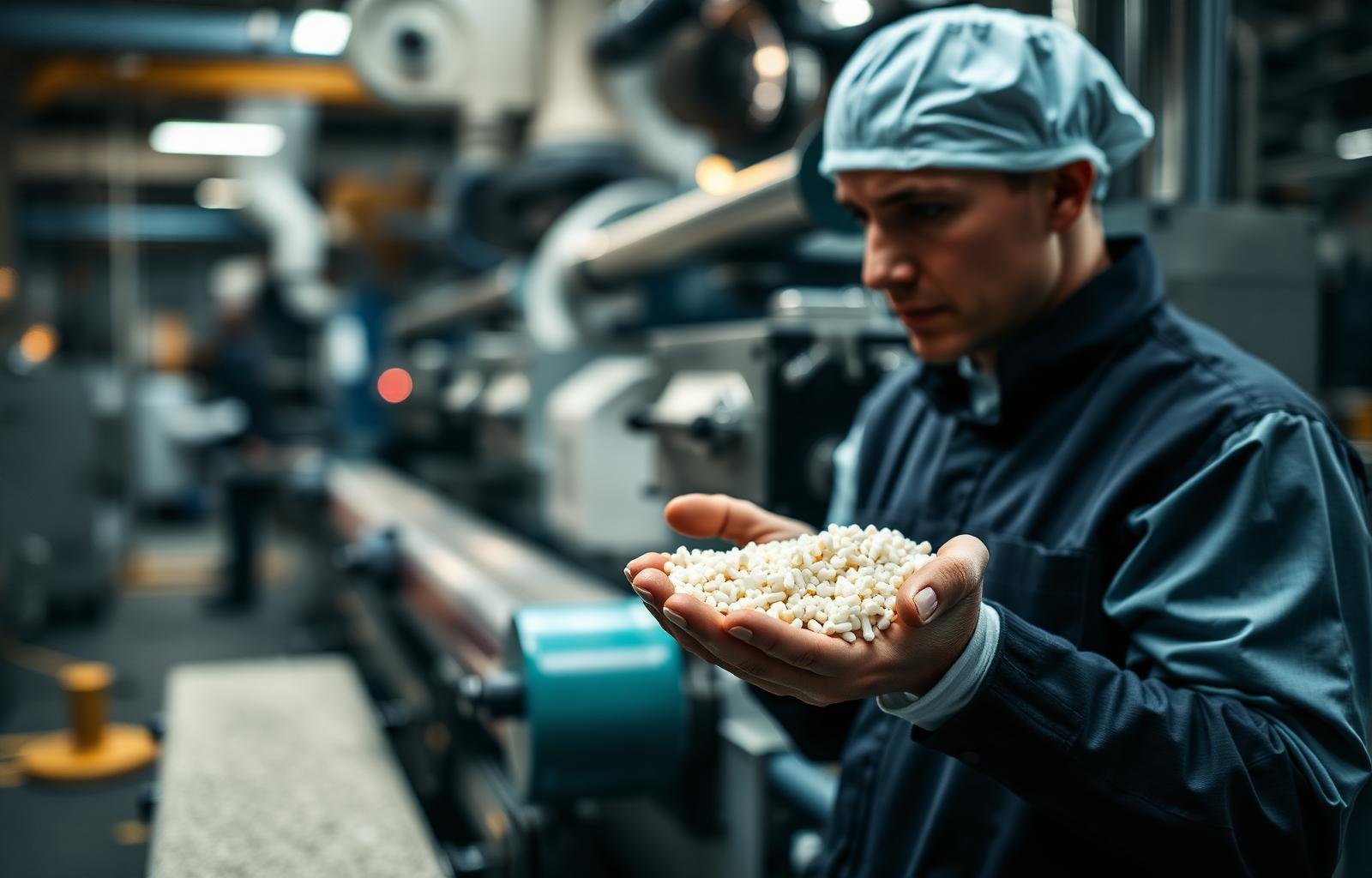
A masterbatch is a concentrate: a carrier resin loaded with a high percentage of additive. On your line it is diluted, or let down, with natural polymer. The let-down ratio (LDR) says how much masterbatch is used for a given amount of polymer.
As a percentage, the let-down is the weight of masterbatch divided by the total weight of masterbatch plus natural polymer, multiplied by 100. Dosing 2 kg of masterbatch into 98 kg of resin gives 2 kg in 100 kg of blend, a 2% let-down.
Ratios are where mistakes creep in. A 1:50 ratio usually means one part masterbatch to fifty parts natural polymer, which is 1 in 51, or about 1.96%. Some suppliers and converters use 1:50 to mean 2% of the total. The difference is small at 1:50 but grows at higher dosages: 1:10 is 9.1% one way and 10% the other. When you agree a dose, write it as a percentage of the total blend.
What matters for performance is the active additive in the final product. Multiply the let-down by the additive concentration in the masterbatch. A 2% let-down of a masterbatch containing 20% active additive gives 0.4% active in the film, or 4,000 ppm. If you switch to a masterbatch with a different concentration, the let-down must change to keep the same active level.
To set the feeder, multiply the line output by the let-down. A blown film line running 300 kg/h at a 2% let-down needs 6 kg/h of masterbatch. In co-extruded film, apply this to the output of the extruder feeding the layer that needs the additive, not to the total line output. Anti-fog, for example, is usually dosed only into the inner layer.
Four checks before you fix the dose.
Agree the let-down as a percentage of the total blend, not a ratio, so everyone reads it the same way.
Confirm the active additive your film needs, then work back to the let-down for the masterbatch you use.
In co-extruded film, calculate the dose for the layer that needs the additive, using that extruder's output.
Volumetric feeders drift with bulk density. Check the real rate by weight, or use a gravimetric feeder.
Higher is not always safer. Too much slip can affect printing and sealing, too much antiblock adds haze, and too much of any additive costs money without improving performance. Too little and the function fails in the field or on your customer's line.
Every Aviura grade comes with a recommended let-down for your polymer and process, set out in its technical data sheet and in our recommendation for your line. Send us your resin, process, film structure and the problem you want to solve, and we will suggest a starting dose for your trial.
Agree the dose as a percentage of the total blend, and you remove the most common masterbatch mistake.
Browse grades