
Hydrogen Pathways
Turquoise Hydrogen vs Green Hydrogen: Cost, Carbon Intensity and Scalability.
As global demand for low-carbon hydrogen accelerates, attention is increasingly turning to the differences between turquoise hydrogen vs green hydrogen. While green hydrogen has dominated headlines, turquoise hydrogen production is gaining recognition as a potentially scalable and cost-competitive alternative.
Understanding the differences between these hydrogen production pathways is critical for investors, industrial buyers, and policymakers evaluating long-term decarbonisation strategies.
What Is Green Hydrogen?
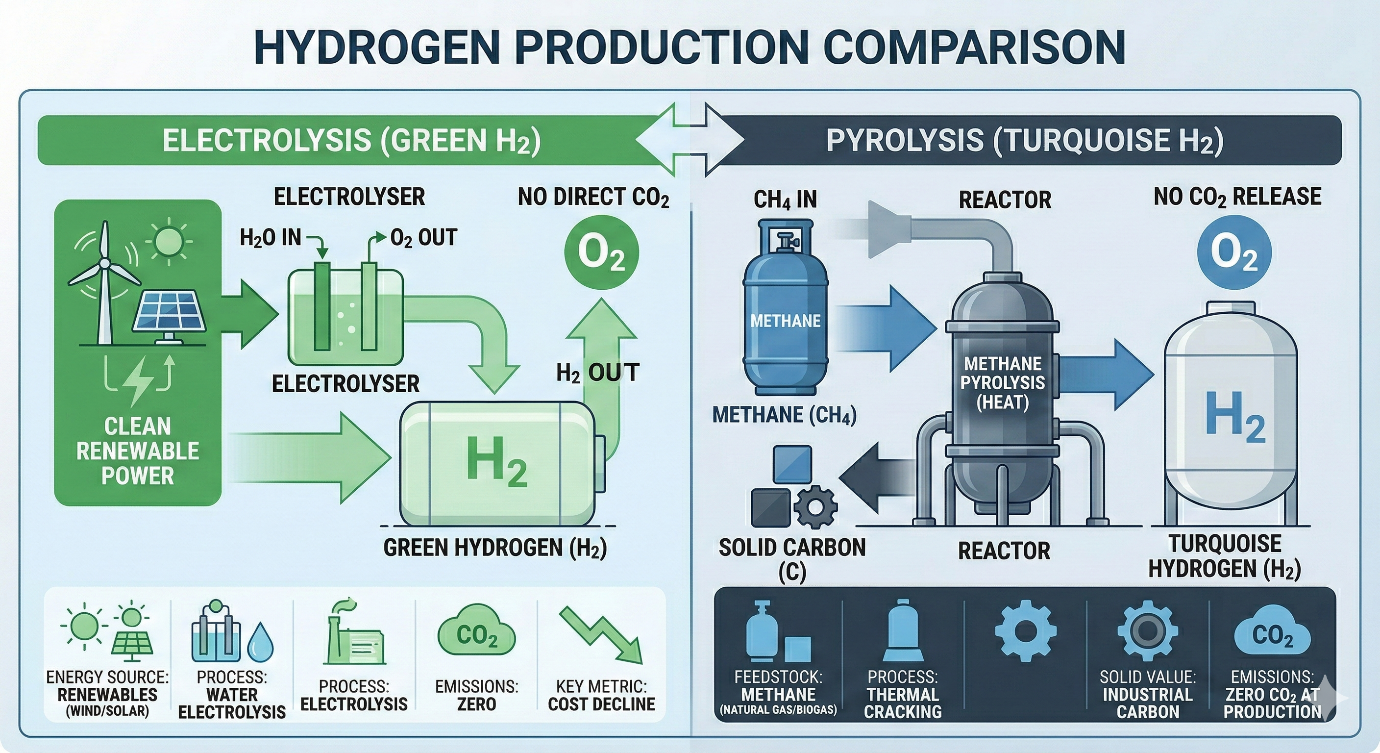
Green hydrogen is produced through water electrolysis powered by renewable electricity, such as wind or solar. The process splits water into hydrogen and oxygen without direct carbon emissions.
Its advantages include:
- Zero direct CO₂ emissions during production
- Alignment with renewable energy expansion
- Strong policy support in multiple regions
However, green hydrogen production faces key challenges:
- High electricity input requirements
- Dependence on renewable energy availability
- Infrastructure and grid constraints
- Elevated levelised cost of hydrogen (LCOH) in many markets
The scalability of green hydrogen is therefore closely tied to renewable power buildout and transmission infrastructure.
What Is Turquoise Hydrogen?
Turquoise hydrogen is produced through methane pyrolysis hydrogen technology, where methane is thermally broken down into hydrogen and solid carbon instead of producing carbon dioxide.
Unlike steam methane reforming (SMR), this process:
- Does not generate CO₂ as a direct byproduct
- Produces solid carbon instead of gaseous emissions
- Can operate with lower electricity intensity than electrolysis
The carbon byproduct can potentially be used in industrial applications, including advanced materials and carbon black substitutes, creating additional value streams.
Carbon Intensity: How Do They Compare?
The carbon intensity of hydrogen depends on:
The carbon intensity of hydrogen depends on:
- Energy source utilised in production
- Upstream methane management
- Process efficiency
- Carbon handling and lifecycle assessment
Green hydrogen’s carbon intensity depends on the renewable energy source. If grid electricity with fossil input is used, emissions rise significantly.
Turquoise hydrogen production carbon intensity depends on:
-
- The energy source driving the pyrolysis process
- Methane leakage management
- Responsible carbon byproduct utilisation
When powered by low-carbon electricity and paired with responsible methane sourcing, turquoise hydrogen can achieve very competitive lifecycle emissions.
Cost and Scalability Considerations
One of the most debated topics in the turquoise hydrogen vs green hydrogen discussion is cost.
Green hydrogen costs are heavily influenced by:
- Electricity prices
- Electrolyser capital costs
- Capacity factors
Turquoise hydrogen economics depend on:
- Reactor design and efficiency
- Methane input pricing
- Carbon byproduct commercialisation
In markets where renewable electricity remains expensive or constrained, methane pyrolysis hydrogen may offer a cost-stable alternative.
Scalability also differs structurally:
-
- Green hydrogen requires massive renewable expansion and grid integration.
- Turquoise hydrogen can integrate into existing natural gas infrastructure while transitioning carbon handling to solid form.
This difference in infrastructure reliance is increasingly relevant in regions seeking faster hydrogen deployment.
Strategic Outlook
The global hydrogen economy is unlikely to be defined by a single production pathway. Instead, a portfolio of low carbon hydrogen alternatives will likely coexist.
The real question is not turquoise hydrogen vs green hydrogen but where each pathway offers the strongest economic and infrastructure alignment.
As hydrogen demand grows, scalable and commercially viable production methods will determine long-term market leadership.