Antistatic vs Conductive Masterbatch: Which One Do You Need?
Plastics are insulators, so they build up static charge. How much control you need decides the additive: a migrating antistatic, a permanent antistatic or a conductive grade. Choosing the wrong one costs money or fails the specification.
Static builds up when plastic surfaces rub or separate, during film winding, bag opening, powder filling or simply handling. It attracts dust to shelves of packaging, makes film cling and jam on lines, gives operators shocks, can damage sensitive electronic components and, where flammable dust or solvents are present, can be an ignition risk. The aim of every static control additive is to let charge leak away before it builds up.
Static performance is described by surface resistivity, in ohms per square. Untreated polyethylene is above about 10^14. As a rough guide, materials from about 10^9 to 10^12 are called antistatic, 10^5 to 10^9 static dissipative, and below about 10^5 conductive. The level you need depends on the application and on any standard your customer applies, so it is worth confirming the target and the test method early.
Migrating antistatic masterbatch, typically based on glycerol monostearate or ethoxylated amines, works like slip: the additive moves to the surface and attracts a thin layer of moisture from the air, which lets charge flow away. It is low cost, effective at small doses and suits general packaging, dust control and household goods. But it depends on humidity, takes time to build up after production, and can be wiped or washed off.
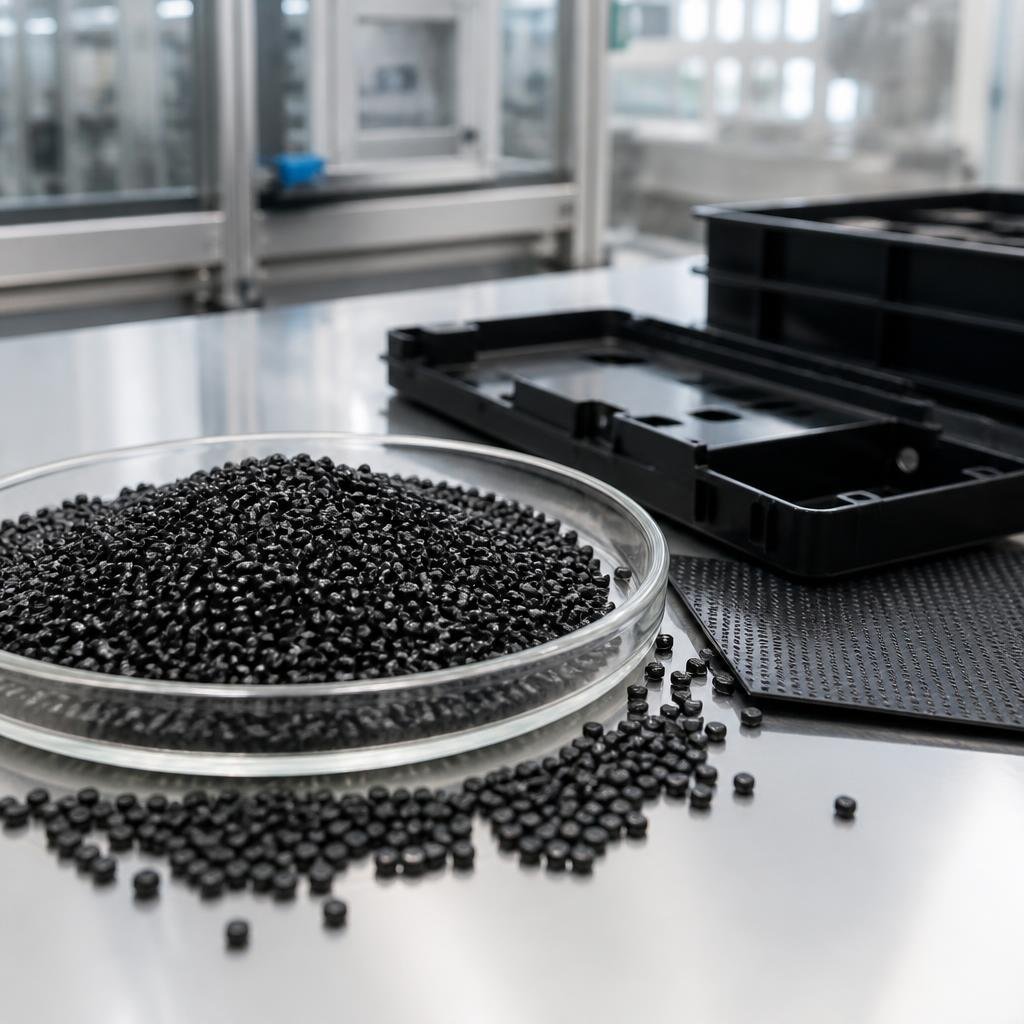
Permanent antistatic masterbatch uses an inherently dissipative polymer that forms a network inside the plastic instead of a surface layer. It works from the moment the part is made, does not wipe off and is much less affected by humidity, which makes it the choice for electronics packaging, cleanroom items and long-life parts. Conductive masterbatch goes further, usually with conductive carbon black, to reach the low resistivity needed for ESD-safe trays, containers and parts, at the cost of a black colour and higher loading.
Four questions that decide the grade.
Antistatic, dissipative or conductive: the target range rules options in or out.
Short shelf life suits migrating antistatic; long service life or reuse needs permanent.
Low humidity, air-conditioned stores and cold chains weaken migrating antistatics.
Antistatic and permanent antistatic can stay clear or coloured; carbon-based conductive grades are black.
Test the way the product is used. Condition samples at the humidity they will meet, measure after the time they will be stored, and check after wiping or washing if that happens in use. A migrating antistatic that passes at 50% humidity the day after production can fail in a dry, air-conditioned warehouse a month later.
Aviura makes AST migrating antistatic, PAS permanent antistatic and ESD conductive masterbatch for PE, PP and engineering polymers, tested for surface resistivity and charge decay. Tell us the product, polymer, required resistivity and conditions of use, and we will recommend a grade and starting dose.
Specify the resistivity, the humidity and the service life, and the right grade follows.
Read the antistatic packaging guide