Slip and Antiblock Masterbatch: How to Control COF in PE Film
Packaging film has to open easily, slide over forming collars and stack without sticking. Slip and antiblock additives make that happen, but they work in different ways and need to be specified together.
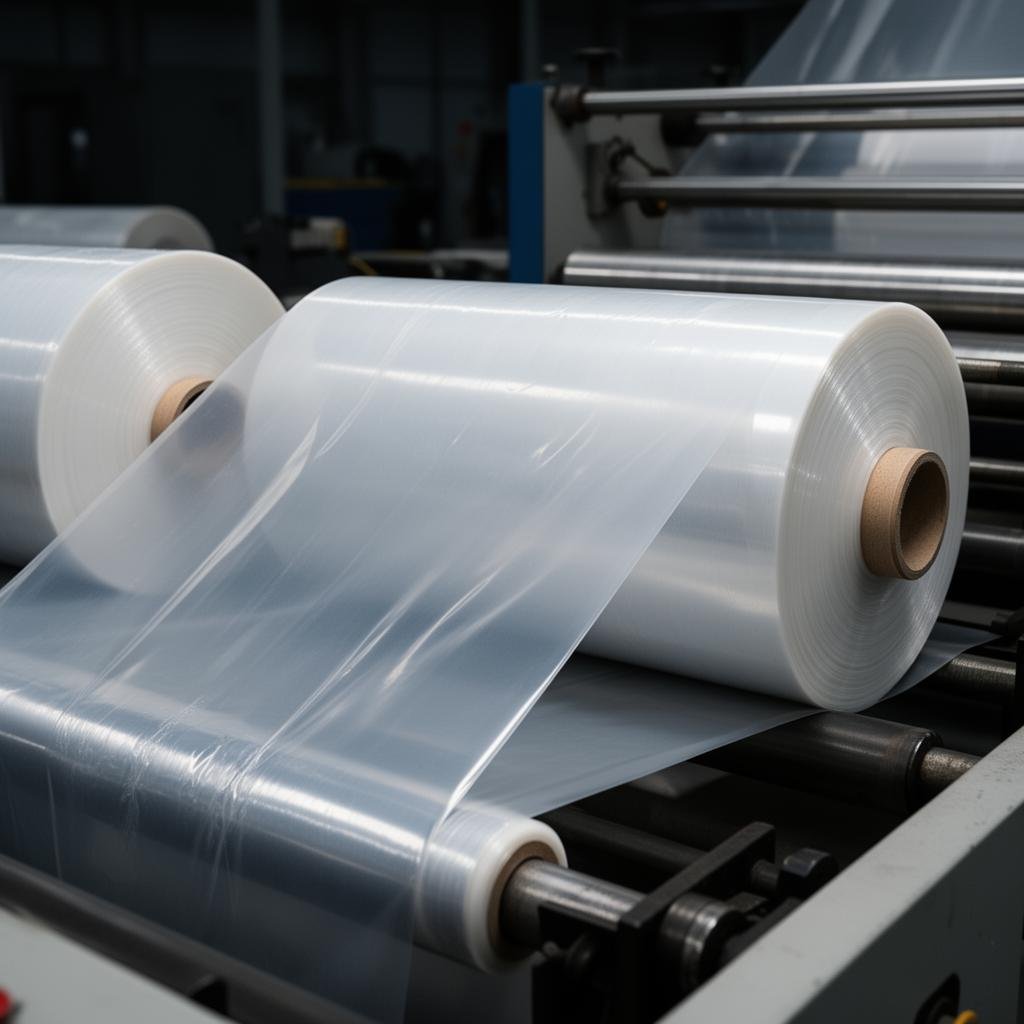
Polyethylene film, and especially LLDPE and metallocene grades, is naturally tacky. Two layers pressed together on a roll or in a bag cling to each other, which is called blocking, and the film drags on metal and on itself, which shows up as a high coefficient of friction (COF). On a fast form-fill-seal line that means film that will not open, packs that jam and wrinkles in the seal.
Antiblock solves blocking. It is a fine mineral, typically synthetic silica, natural silica or talc, dispersed in the film. The particles create tiny bumps on the surface that hold the layers slightly apart, so air can get between them and they separate easily. Antiblock does not migrate, so its effect is there as soon as the film is made, but more antiblock means more haze, which matters for clear packaging.
Slip lowers COF. The common slip additives are fatty acid amides such as erucamide and oleamide. They are partly incompatible with polyethylene, so after extrusion they migrate to the surface and form a thin lubricating layer. Oleamide moves quickly and gives low COF soon after production; erucamide moves more slowly but is more heat-stable and gives a lower final COF, which makes it the usual choice for packaging film.
Because slip has to migrate, COF is not fixed when the film leaves the line. It usually keeps falling for days, faster in warm storage. Slip can also be lost: it can transfer to the other side of the film on the roll, be absorbed into a laminate adhesive, or be disturbed by corona treatment. That is why COF is measured on aged film, and why the slip dose has to account for the full structure, not just one layer.
How to get the COF you need.
State static and kinetic COF, film-to-film or film-to-metal, and when it is measured after production.
In co-extruded film, slip and antiblock usually go in the skin layers, where the surface is.
Adhesives and some print inks absorb slip. Laminated film often needs more, or a non-migrating approach.
Use the lowest antiblock level that stops blocking, and finer particles for clear film.
A combined slip-antiblock masterbatch puts both additives in one dose, which simplifies the feeder setup and keeps the ratio between them fixed from batch to batch. Separate slip and antiblock grades give more freedom to tune each one, which is useful when the same line runs several film types.
Aviura makes SLP slip, ABK antiblock and SAB combined slip-antiblock masterbatch for PE and LLDPE packaging film, tested for COF, blocking and haze. Send us your film structure, line speed and target COF, and we will recommend a starting dose for a trial.
Measure COF on aged film, in the structure you will actually ship.
Read the slip and antiblock guide