Masterbatch Carrier Resin: Why Compatibility Matters
Most of a masterbatch pellet is not the additive. It is the carrier resin that holds the additive together, and if that carrier does not suit your polymer and process, even the right additive at the right dose can give poor results.
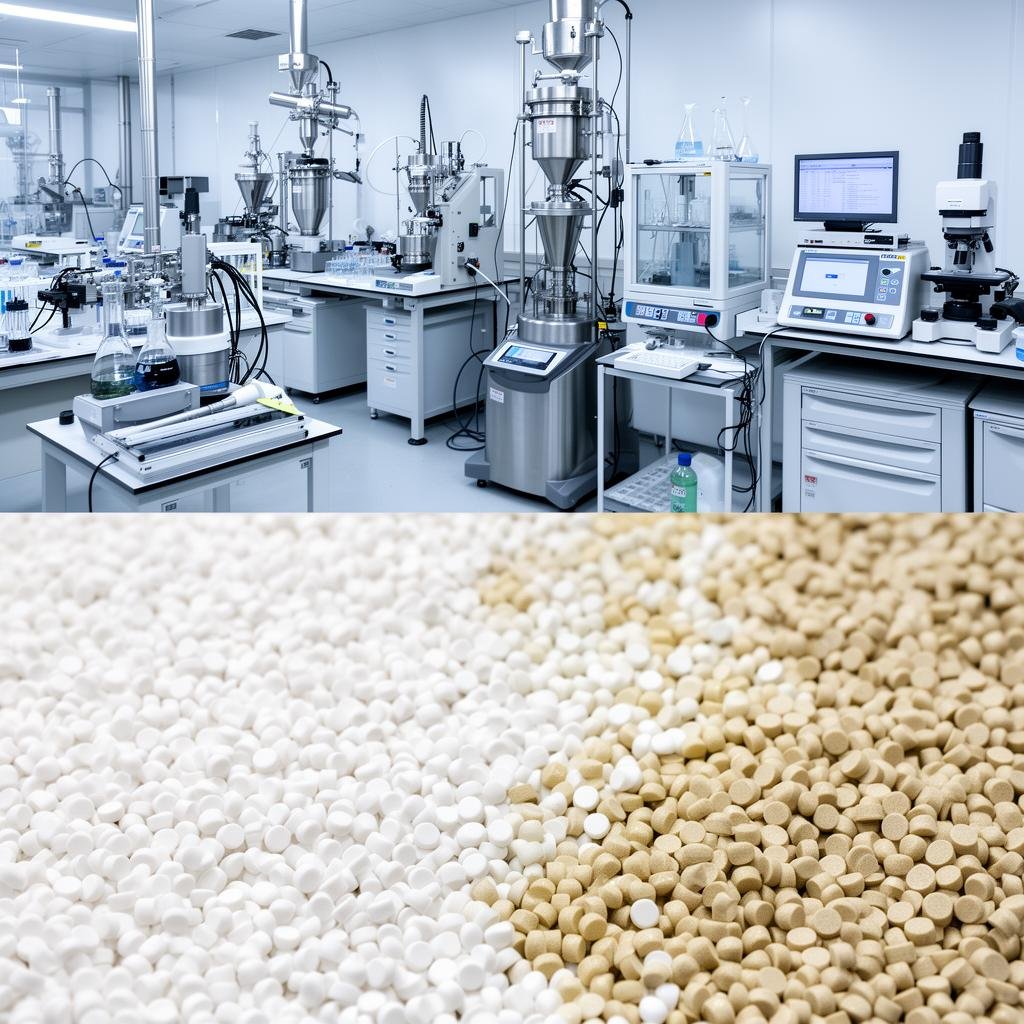
A masterbatch is a concentrate: a high loading of additive or pigment dispersed in a polymer called the carrier. When you add the masterbatch to your main resin, the carrier melts and mixes with it, releasing the additive into the melt. For that to happen evenly, the carrier has to melt at the right time, flow at a similar rate and be compatible with the polymer it is joining.
Melt flow is the first thing to check. If the carrier is much more viscous than your resin, it may not mix fully before the melt leaves the screw, which shows up as streaks, gels or unmelted spots, especially in thin film. If it is far more fluid, it can coat the pellets of the main resin and slip past without mixing. Carrier suppliers usually aim for a melt flow similar to, or a little higher than, the resin it is designed for.
Polymer type matters too. Polyethylene carriers, often LDPE or LLDPE, suit most PE film and moulding. Polypropylene products are usually better served by a PP carrier, because PE in PP can reduce clarity, stiffness and heat resistance at higher loadings. Some masterbatches use a universal or wax-based carrier to work across several polymers; these are convenient but are not always the best choice for demanding film or engineering applications.
The carrier also affects the finished product. A low-melting carrier helps dispersion but can change seal behaviour or stiffness at higher let-downs. In food-contact products, the carrier must be covered by the declaration, not just the additive. And at very low let-down ratios, the carrier is such a small part of the blend that compatibility problems often only appear when the dose is pushed up.
Four checks before you approve a masterbatch.
Ask what the carrier is, and whether it matches your resin type: PE, PP or another polymer.
Compare the carrier's melt flow with your resin, at the same test conditions.
Confirm compatibility at the highest let-down you might use, not just the typical one.
Make sure food-contact and other declarations cover the whole masterbatch, carrier included.
If you see streaks, gels, haze or patchy performance after adding a masterbatch, check the carrier before you raise the dose. A better-matched carrier often solves the problem at the same or a lower let-down.
Aviura chooses the carrier for each functional grade to suit the polymer and process it is designed for, mainly PE and PP, and can adjust it for custom grades. Tell us your resin grade, melt flow and process, and we will confirm the best match before you trial.
The additive does the work, but the carrier decides whether it gets to where it is needed.
Read: what is masterbatch?